
AI Research
Adaptive Intelligence for Open, Non-Stationary Systems
NodeAsset builds real-world adaptive intelligence systems that learn directly from interaction with complex environments without human imitation, static datasets, or centralized control.
This public research page describes the foundations behind NodeAsset systems that generate adaptive intelligence telemetry, research dashboards, and licensed intelligence data products.
Research Lineage and Intellectual Foundations
NodeAsset’s work builds on a foundational research trajectory established by DeepMind’s AlphaGo and AlphaZero programs, and more directly by the AlphaStar framework. These systems demonstrated that reinforcement learning, self-play, and population-based training can produce strategic behavior that exceeds human performance without relying on imitation or static datasets ( DeepMind, Mastering the Game of Go without Human Knowledge ).
AlphaStar is particularly relevant because of its use of specialist agents operating within a coordinated population. Rather than optimizing a single monolithic policy, AlphaStar evolved diverse specialists whose interactions produced robust, generalizable strategies ( DeepMind AlphaStar research ; Nature publication ).
NodeAsset generalizes these principles beyond closed games into open, non-stationary, real-world environments where rules evolve, feedback is delayed, and intelligent agents adapt continuously. Related research in swarm intelligence and robotics and application-driven innovation in machine learning informs this public research direction.
Deployment Is the Research
At NodeAsset, production environments are treated as sources of knowledge, not as an end state. Deployment is the mechanism by which learning occurs. Systems operate as a closed adaptive loop in which exploration, execution, feedback, and evolution occur continuously in live environments.
- No expert demonstrations
- No predefined strategies
- No centralized control
Strategic structure emerges directly from interaction with the environment. Successful behaviors reinforce shared environmental signals, while ineffective strategies decay naturally over time.
Adaptive Neural Network Trading
We validate the adaptive intelligence framework using financial markets as a high-feedback testbed. Markets provide adversarial pressure, rapid regime shifts, and dense multi-agent interaction, making them useful for stress-testing adaptive systems.
Trading is used as a research vehicle. The demonstrated ability to adapt under extreme volatility motivates extension into other domains, including hospitality, logistics, cybersecurity, and oncology.
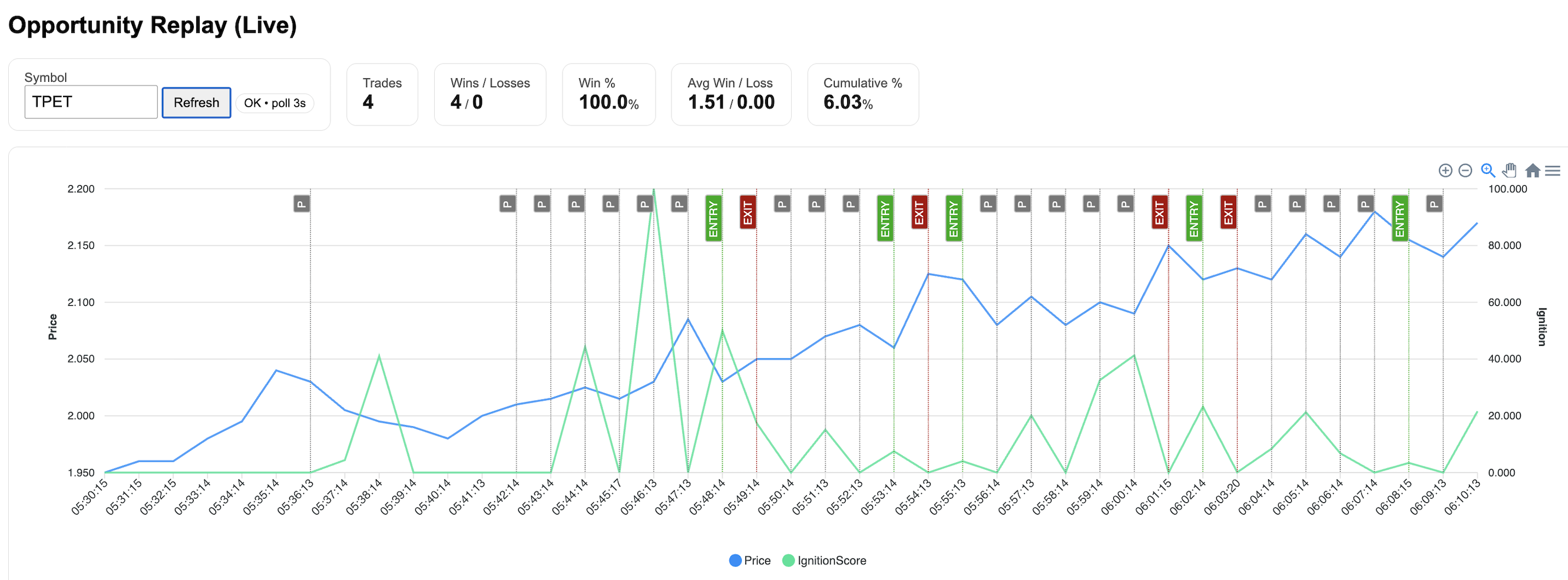
Artificial Evolution in Open Decision Environments
Open systems are characterized by partial observability, delayed feedback, adversarial dynamics, and continual regime change. Agents must decide what to do, when to act, how much to commit, and when to disengage.
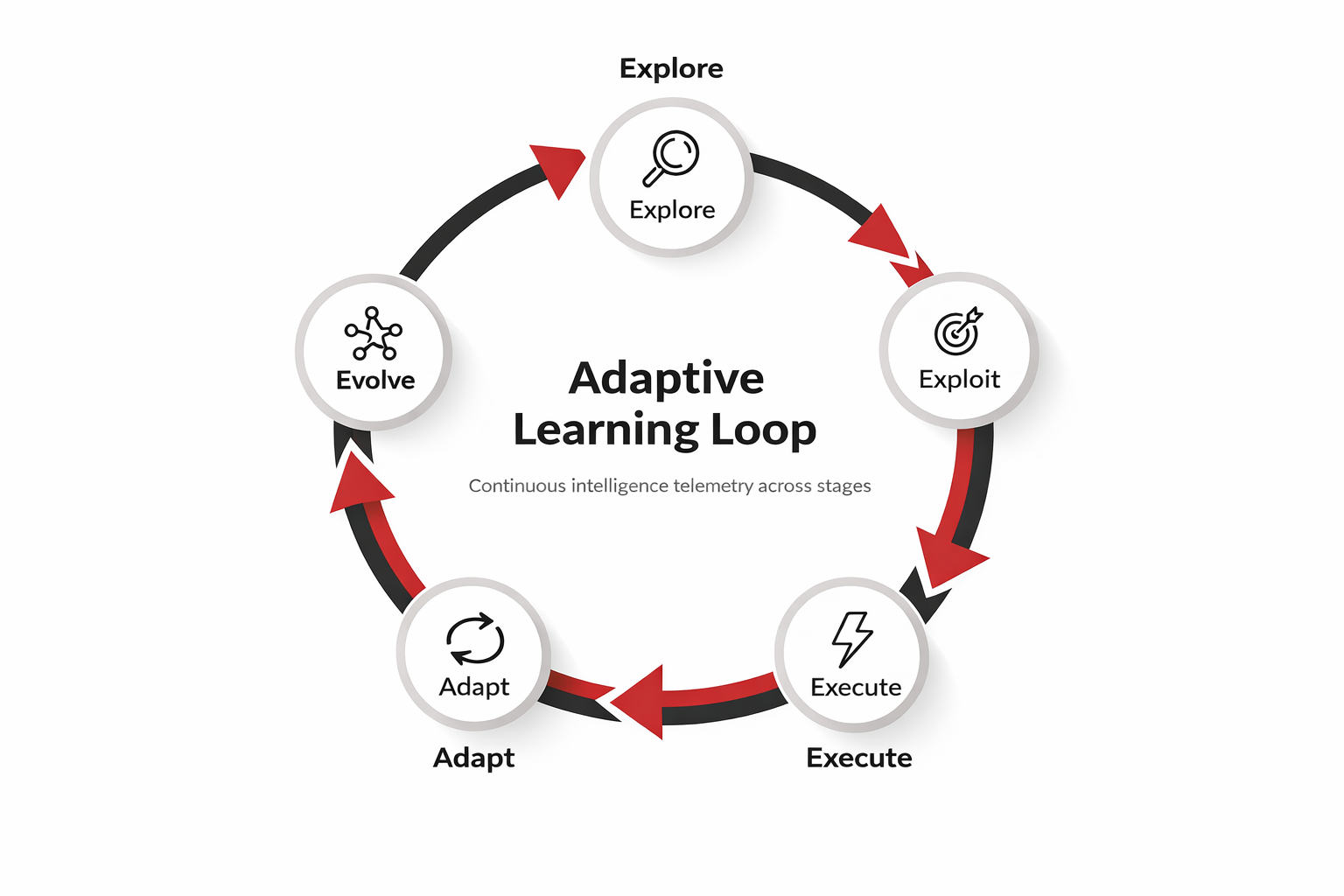
Learning Loop Telemetry
Each stage of the adaptive learning loop emits structured intelligence telemetry that is versioned and exposed through dashboards and APIs as licensed data products.
- Explore: probe uncertainty to surface novel structure and emerging regimes.
- Exploit: transition from exploration to selective commitment when confidence thresholds are met.
- Execute: translate intent into constrained, auditable real-world actions.
- Adapt: absorb delayed and noisy feedback to recalibrate beliefs.
- Evolve: reconfigure model populations over time with versioned updates and lineage.
Conversational Interaction with Adaptive Intelligence
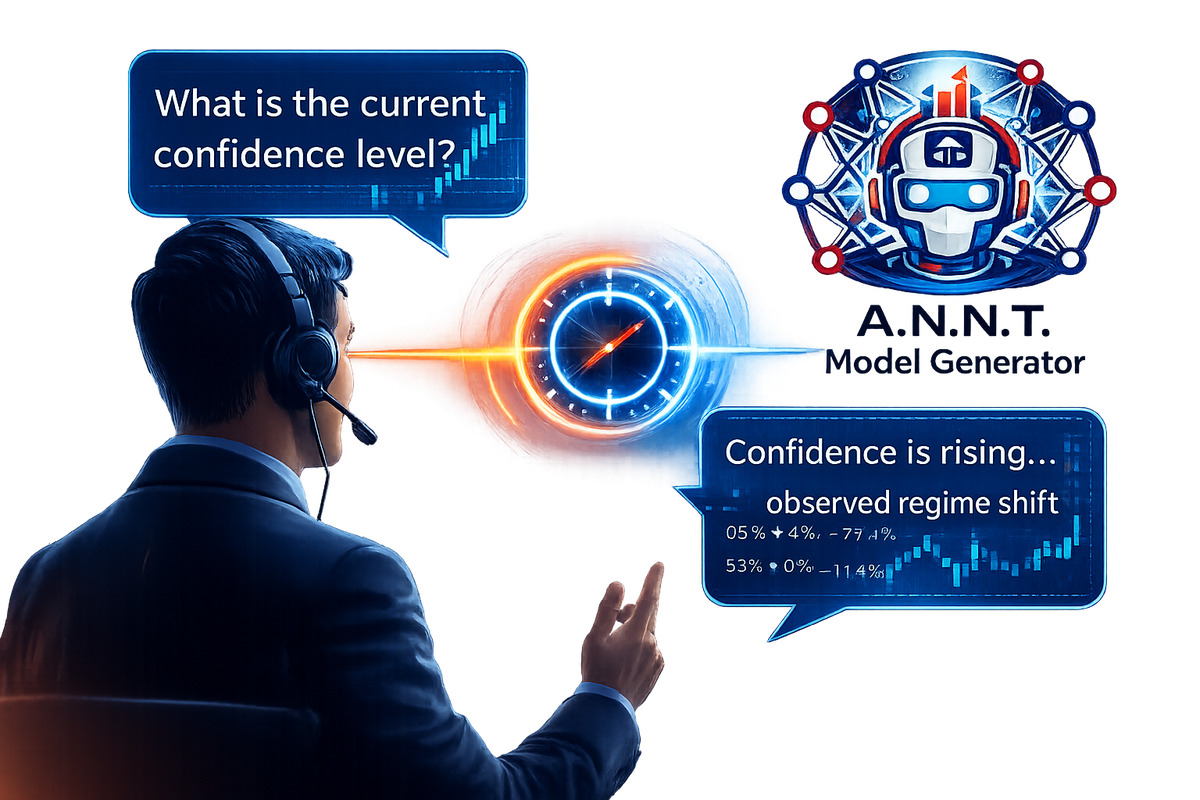
Because the system exposes its internal learning state in structured, interpretable form, institutions can query confidence, regime conditions, uncertainty, and historical analogs while decisions are being made.
The system responds using the same internal intelligence telemetry generated by the autonomous learning loop, grounded in live observations rather than static rules or post-hoc explanations.
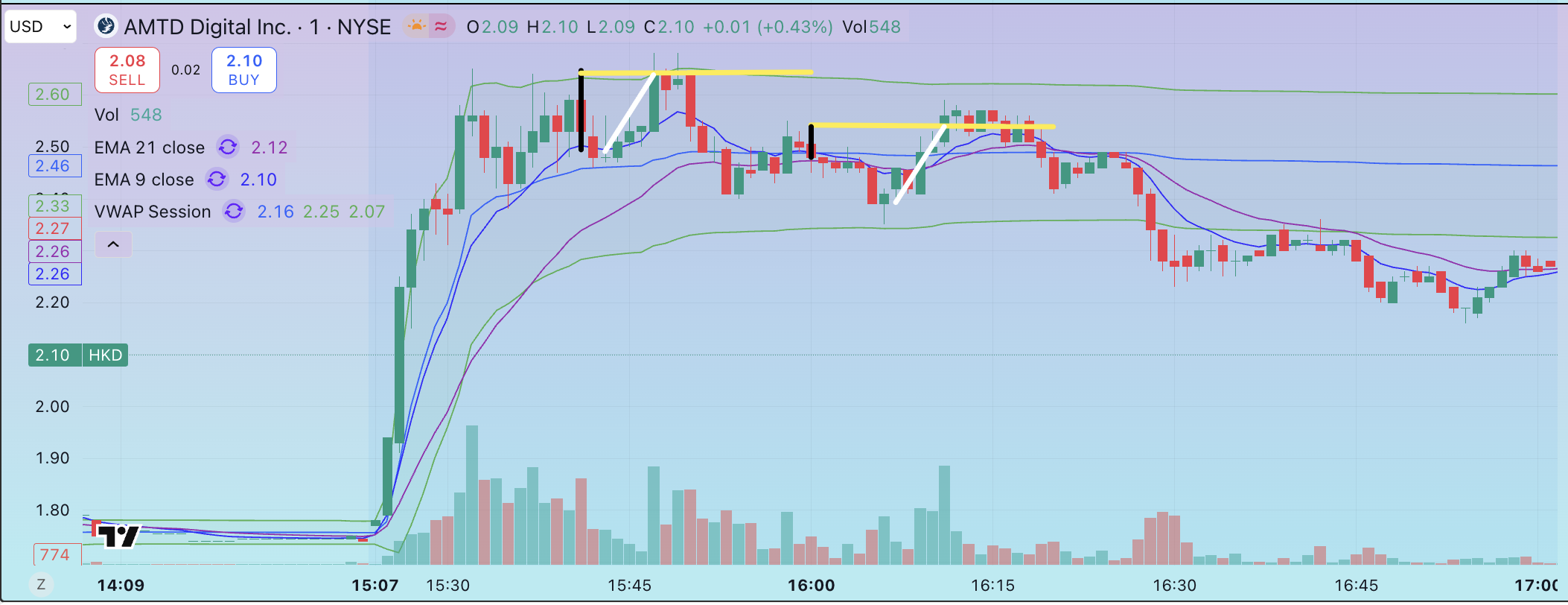
Empirical Results
The A.N.N.T. dataset captures repeated, interpretable behavioral structures that emerge from live interaction in high-volatility market conditions. Commonly observed structures include trend continuation, mean reversion, high-of-day breakouts, and chop adaptation.
Live Dashboard Interface Example
The A.N.N.T. Dashboard surfaces environmental observations and agent activity across a monitored universe. Each row represents an instrument currently being evaluated by the system.
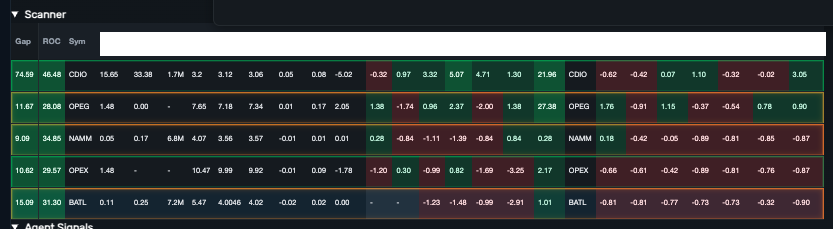
Color-coded cells and row outlines help operators interpret evolving market structure faster than raw numerical data alone. In this configuration, A.N.N.T. functions as a co-pilot that augments human judgment while preserving operator control.
Conclusion & Collaboration
Adaptive intelligence in open systems cannot be solved through imitation, static data, or closed benchmarks. It requires deployment, failure, adaptation, and evolution.
AlphaGo to AlphaZero to AlphaStar represents the progressive removal of human scaffolding in closed systems. A.N.N.T. extends that trajectory into open, non-stationary systems, where most real-world problems live.
NodeAsset invites collaboration with researchers, clinicians, and partners interested in building production-grade adaptive systems that augment human judgment.